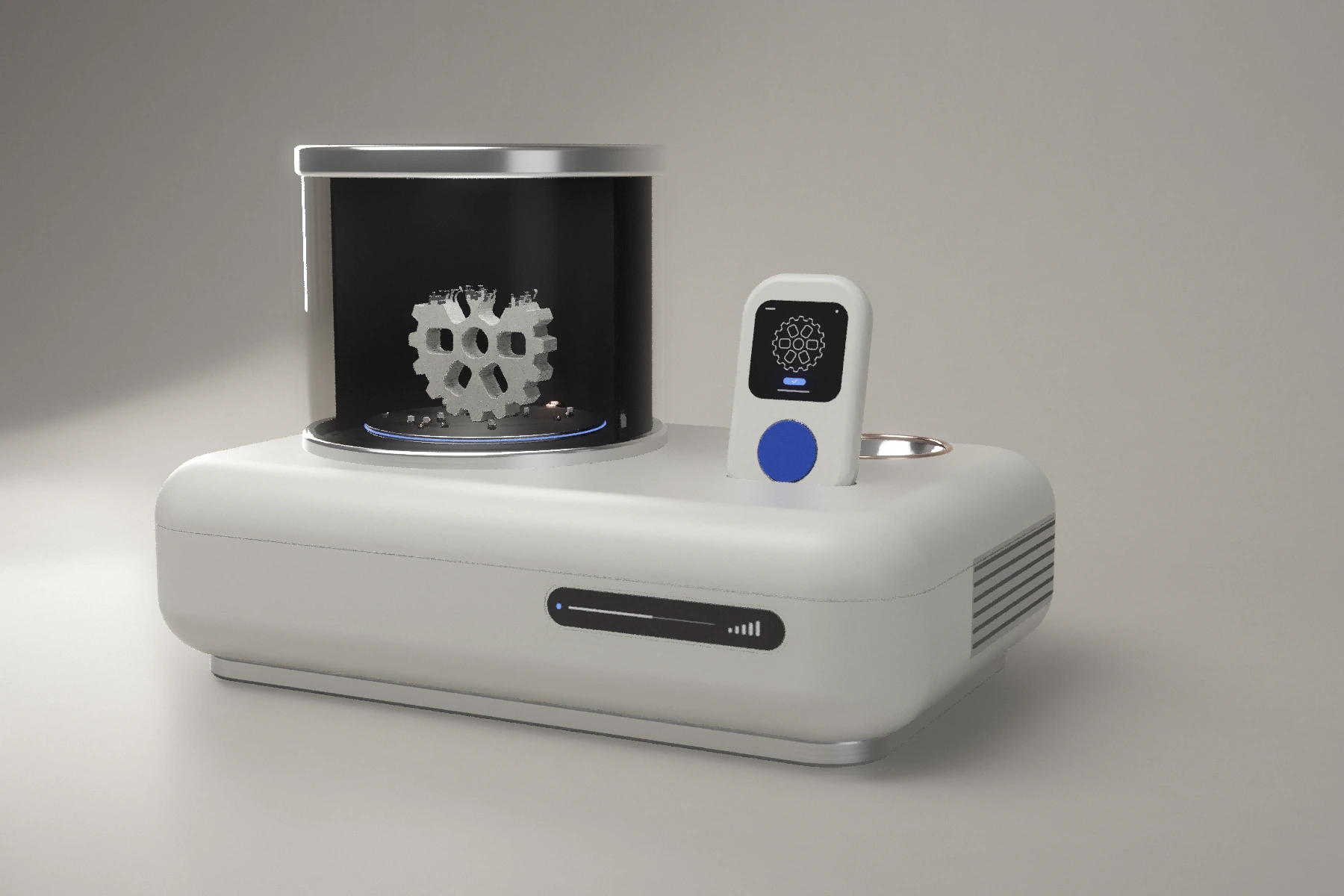
Every machine we make starts from four blocks.
An insulator, a conductor, a spring and a contact. That's the whole parts list, and the machine builds its own motors and logic from it.
Four standard blocks, drawn as specimens: a stiff insulator spacer, conductor plates, a springy serpentine flexure and a tipped contact. They assemble into three devices. An actuator is a conductor plate on an insulator, an insulator spacer and a second conductor plate held on flexures; charging the plates pulls them together. A relay is the same actuator with a contact added, so the moving plate closes a circuit. A sensor is the same plates read as a capacitor, whose value rises as the gap closes. The actuator and sensor use three of the four blocks; the relay uses all four. Select a block or a device to highlight it.
We're replacing the motor with static electricity.
Charge two plates and they pull together, so the machine moves using nothing but its own blocks.
Block size 100 µm: plate area is 10⁴ times smaller and volume 10⁶ times smaller than at 1 cm, so area per volume is 100 times larger.
We're building the logic from the same parts.
Add a contact and the actuator becomes a switch, the same kind that ran the first computers. No chips required.
Step: check. Cycle 0.
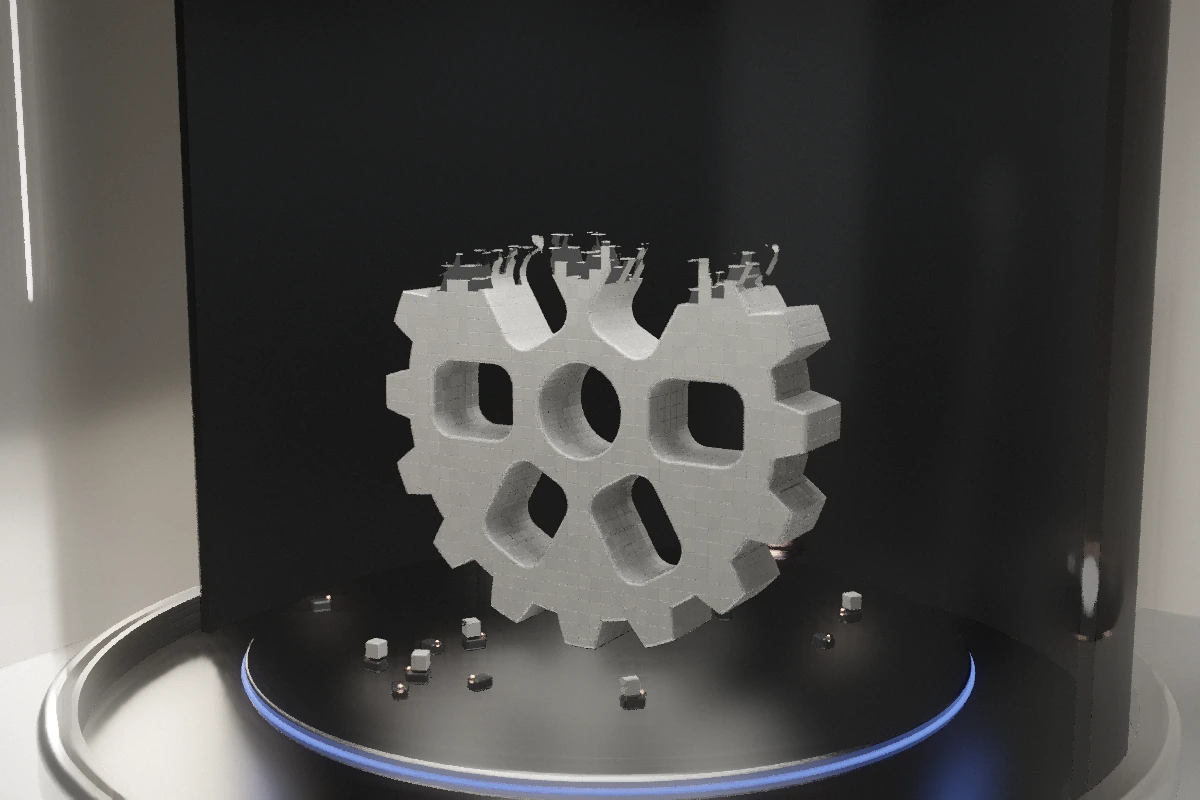
It checks every block the moment it lands.
The gripper doubles as a sensor, so a mistake gets fixed before the next block goes down.
We build the builders first.
One machine placing parts will never be fast enough. Builders that copy themselves grow exponentially, then turn to the job.
Time runs left to right and mass built runs up on a log scale. One machine placing parts directly accumulates mass in a straight line and stays far below the one kilogram product line. A seed that first copies itself doubles in number with every doubling time, a target of under 24 hours, until the dock's limits on power, heat and feedstock bend the curve into a ceiling. It then switches to building the product and crosses the one kilogram line. A faint curve shows raw doubling with no limits, which overstates output. Move the switch moment and the ceiling to see when each strategy reaches one kilogram.
The heavy lifting stays on the desk.
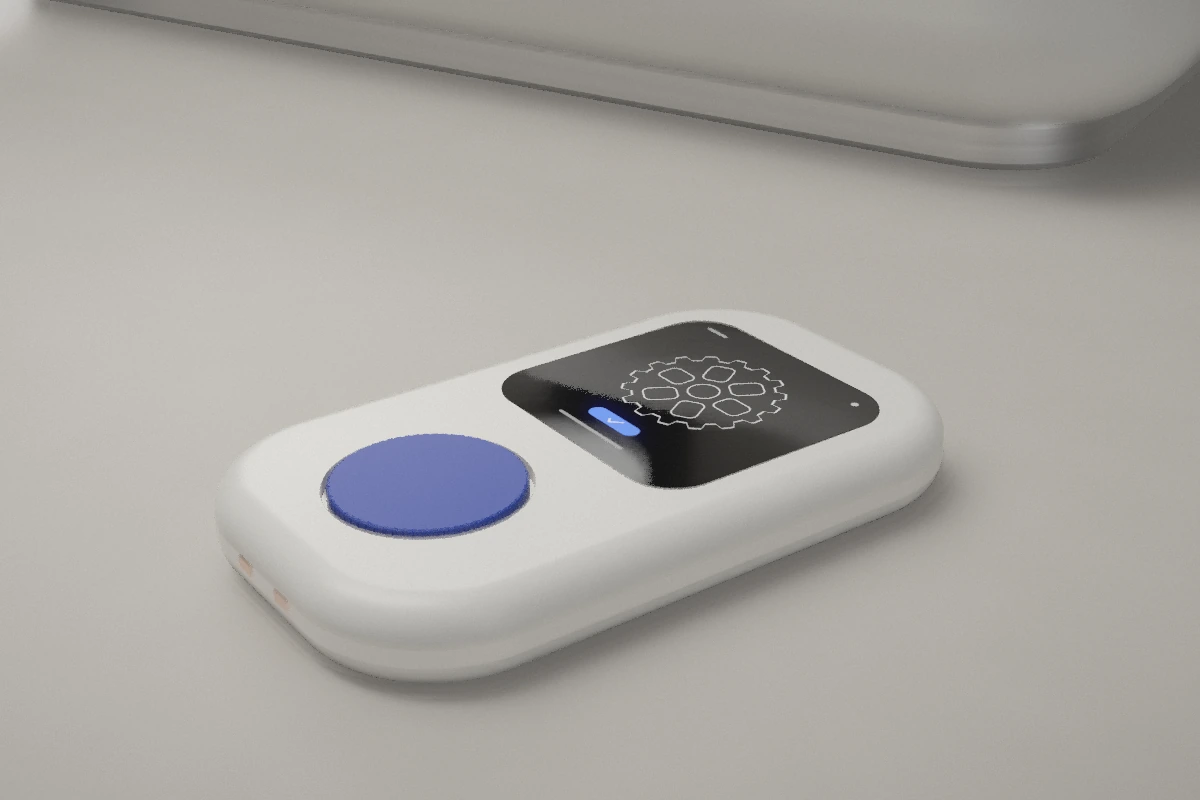
The dock handles the power, the heat and the raw material. The handheld only plans, signs and checks, so it runs on less than four watts.
We prove every step before we take the next.
Right now we're testing all of it in simulation. Hardware comes when the models pass.
The roadmap as six stages over about eight years, drawn as a canal of locks; each stage ends in a gate that opens only when the stage has shown it works, and the first two stages can loop back and repeat. Prove it in simulation: Computer models of every part show what works before anything is built. Build the first parts by hand: Real moving and switching blocks are made by hand and checked against the models. Build a machine that builds: A machine made of blocks puts blocks together, with fewer than one mistake in 10,000. Make it build itself: A builder makes working copies of itself, so capacity can grow on its own. Put it in your hand: A pocket device stores the designs, plans the work and checks each result. Feed it scrap: Raw material and scrap are turned into all four kinds of block. The first stage, prove it in simulation, is under way. All spans are estimates.
We're building the limits into the machine itself.
It can't build without parts from the dock, it won't run an unsigned design, and it stops copying at a hard limit.